
| 1_ |
NTSC:
Introduction |
| 2_ |
Scanning,
Timing/Sync, Sync Recovery, Numbers |
| 3_ |
Gain
& Offset, D.C. Restoration, Gamma Correction |
| 4_ |
Resolution,
Bandwidth, Spectrum |
| 5_ |
Color Physics: Eye, CIE |
| 6_ |
Color
Encoding: Color Bars, Camera,
RGB,
YIQ, Color Subcarrier |
| 7_ |
Color
Decoding: |
| 8_ |
Digital
TV/Graphics: ADC-DAC, Frame Buffers, Timebase Correction, VGA |
| 9_ |
VCR:
Spectrum, Circuits |
| 10_ |
Circuits
& Practices: D.C. Restore, Proc Amps, DAs |
|
|
|
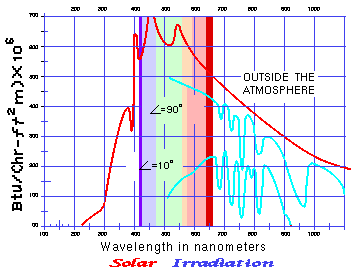 |
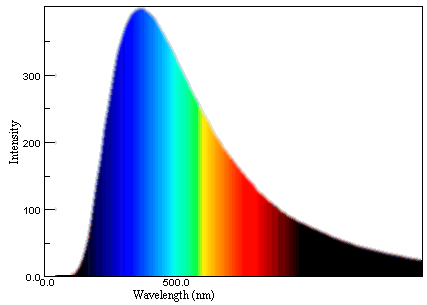
| A blackbody is something which absorbs all the energy it receives,
heats up to a certain temperature, and then reradiates the energy with
a characteristic spectrum defined by that temperature. |
|
|
 |
| The light that lights up our world and allows us to see that world
is solar energy in what is known as the visible region of the Spectrum.
This visible region is a very narrow segment of this spectrum extending
from ~ 440nm in the extreme blue (near ultra violet) to ~ 690 nm in the
red region--with green in the middle @ ~ 555 nm. |
|
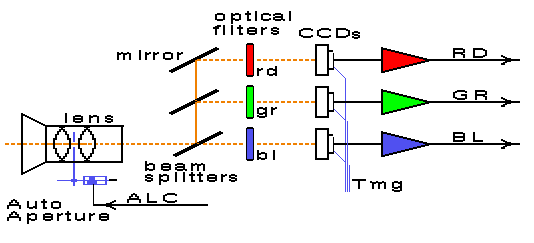 |
| Color cameras are designed to "see" three (overlapping) segments of
this spectral continuum by the action of red, green and blue optical bandpass
filters. The encoded color signal from the camera does not convey any real
wavelength information relative to the original hue. For example, if a
predominantly orange color is imaged the red sensor will describe the light
as some intensity of Red only. |
|
|
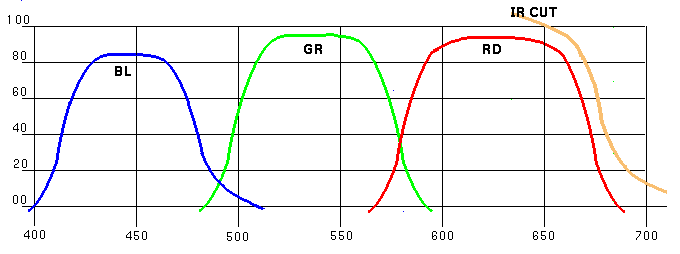
An ideal transfer function in this overlapping selectivity would be
such that as one filter's selectivity increases the adjacent filter's selectivity
decreases having a total gain of unity throughout this continuum.
On the display side of this arrangement is a display
device capable of producing only three narrow nearly discreet wavelengths
of Red, Green, and Blue light. This is a result of electron bombardment
of certain selected phosphors inside the CRT, each releasing a quanta of
photons which are essentially "Monochromatic. "The wavelength of which
is a function of each's atomic structure. |
|
|
|
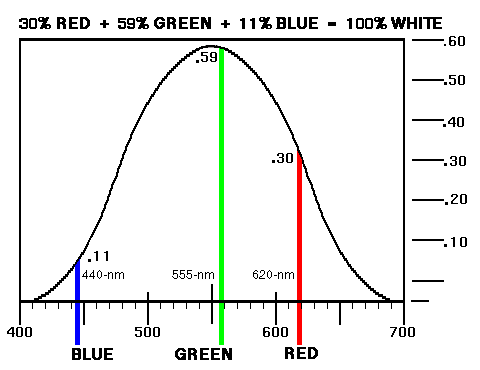
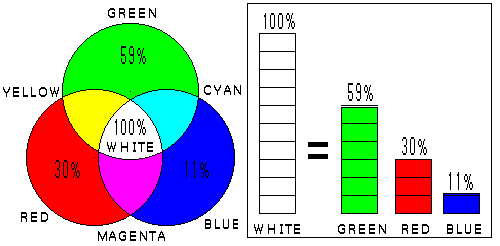
| The addition of colors in the correct proportion creates white; unlike
paint which darkens, e.g., black is the addition of Yellow, Cyan and Magenta
pigments. |
| |
| For example, in order to produce "White" light to the human observer
there needs to be 11 % blue, 30 % red and 59% green (=100%). |
|
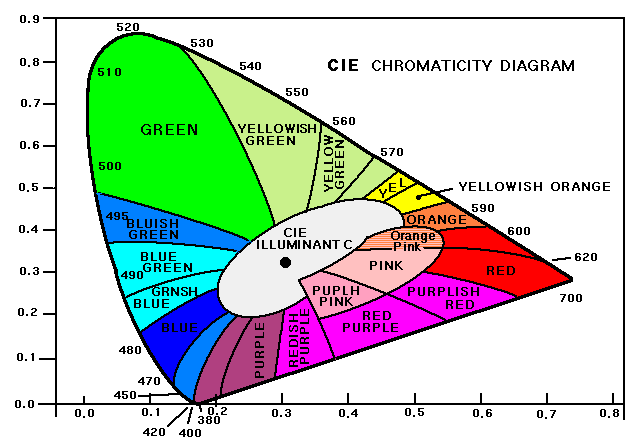
| However, if you shifted, say the red light source to a longer wavelength,
the white light would appear more toward cyan. White balance could be restored
by changing the three color's weights, i.e. other than the original 11,
30, 59 percent ratios. One point should be made: the human observer is
very discriminating when it comes to flesh or skin tones. |
|
|
|

|
|
|
Television-For-EEs
Television
Technology for Engineers, Technicians & Hobbyists
| Television
encompasses more subject areas than any other single technology. You learn
switching power supplies, perception, wireless communications, ergonomics,
physics: --the list is endless... |
|
|
|
|
|
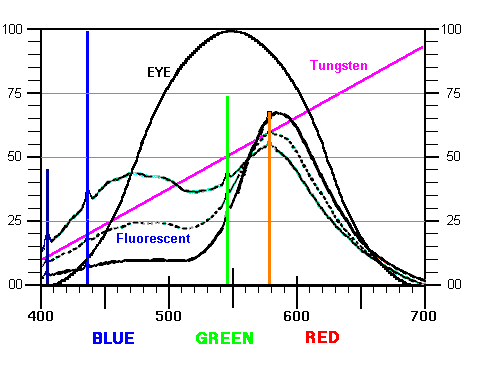
Artificial Light Spectra
|
 |
|
 |
|
Another view of Black Body Radiation
|
|
|
| However, the green sensor will also image some part of this orange
light and convey some intensity of what is essentially green light. This
only works because the optical color filters are bandpass in nature and
posses finite selectivity. If they were discrete monochromatic filters
the color imaging system would fail. This points out the ratiometric nature
of this imaging system, i.e., the overlapping gradual gradation of the
color filters--all three filter have a weighted proportion of the visible
spectrum. |
|
| This all works because human vision can be easily fooled when it comes
to absolute color discrimination. Within reason, the actual color or hue
of each of these three colors is not critical.
Each phosphor is formulated as a compromise between its quantum efficiency
and desired hue or color. An example of this is the fact that red phosphor
requires more energy to cause it to "appear" equally bright to the human
observer. Evidence of this can be seen when a CRT is over driven, the first
color to bloom, is red.
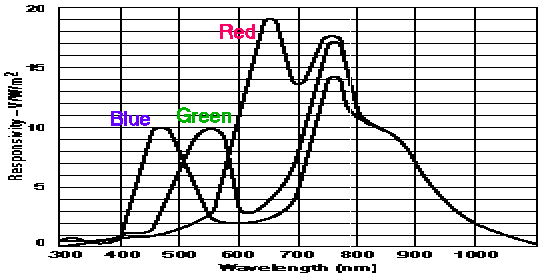
By now it may be obvious that an imaging system for people is different
than one for machines. Machine vision is not weighted to complement a second
vision system--the human eye. |
|
|
Texas Instrument's TC236 CCD Sensor Spectral Response
|
|
|
|
|
|
|
|
